

K-Drama MBTI: All 16 Types as Drama Leads
K-drama has a habit of building its leads out of one very legible trait and then spending sixteen episodes stress-testing it. That makes the genre unusually good for personality reading: you rarely have to guess what a character values, because the script will put them in a room where valuing it costs them something. Below is one drama lead for each of the 16 MBTI types, along with the three lead archetypes the genre keeps reusing and why the second lead so often fits you better than the first.
These are our readings of fictional characters, not official types — no production company issues an MBTI result with the credits. If you want your own four letters before you scroll, take our FREE 16 Personalities - Tadaland MBTI Test! and then find your row.
Why K-drama characters are unusually easy to read
A film gives you two hours and one crisis. A K-drama gives you sixteen hours and a dozen, and that difference is why the typing is more reliable here than almost anywhere else in fiction. A type is not a mood or a look — it is a pattern of decisions repeated under pressure. Two hours rarely shows you a pattern. Sixteen does.
The genre also has a habit of putting characters in situations where their values cost them something. The lead is offered the easy version of what they want and turns it down; the second lead is handed a chance to expose a rival and does not take it. Those scenes are the useful data. A character who is kind when kindness is free tells you nothing at all. A character who is kind when it costs them the promotion tells you a great deal.
Then there is the grammar of the genre. K-drama externalises interior life in ways Western television usually will not: the long unbroken silence after a question, the meal scene that is really a negotiation, the flashback that arrives forty minutes later and reframes a decision you had already judged. You get to see the deliberation, not just the outcome — which is precisely the thing personality frameworks care about and precisely the thing most fiction hides.
Finally, ensemble casts are built on contrast by necessity. Writers do not use MBTI, but they arrive at the same place, because a cast where everyone processes the world identically has no friction and therefore no story. That is why the five doctors in one hospital drama feel like five distinct operating systems rather than five variations of nice.
How to type a character properly, and the mistake almost everyone makes
The mistake is typing on vibe. Someone is quiet and well-dressed, so they get called INTJ; someone cries in episode four, so they get called INFP. Aesthetic is not personality, and a list built that way tells you about costume design rather than character.
The method that actually works is to ignore how a character seems and watch what they do at the three or four moments the plot puts a real cost on the table. Ask: when they had to choose between the plan and the person in front of them, which did they protect? When they were hurt, did they withdraw to think or go and find someone? When they wanted something, did they build towards it over episodes or move on it that night? Answer those and you have a type. Skip them and you have a horoscope.
Three traps are worth naming, because they account for most of the arguments in the comments.
Warmth is not Feeling. A Thinking type can be enormously warm; they simply arrive at kindness through what is fair rather than through what will hurt least. Plenty of characters read as F to viewers purely because they are gentle on screen.
Competence is not Thinking. The most organised, decisive person in a drama is very often a Feeling type running an ironclad set of values. Confusing capability with the T/F axis is the single most common error in fan typing.
A wound is not a type. A great many K-drama leads are withdrawn because something happened to them, not because they are introverts. Watch how they behave once they are safe — around the one person they trust — and you will usually see the actual preference underneath the damage.
And when two readings genuinely both fit, the tiebreak is to look at the character when they are exhausted rather than when they are performing. That is the same rule that works on real people, which is the whole reason this exercise is worth anything.
All 16 types as K-drama leads
| Type | Character | Tadamate | Why we read them this way |
|---|---|---|---|
| ISTJ | Park Sae-ro-yi (Itaewon Class) | Beanie 腰豆蟻 | A fifteen-year plan, written down and followed literally, with principles he will not trade even when trading would obviously work |
| ISFJ | Moon Gang-tae (It's Okay to Not Be Okay) | Mozzarella 芝心雞 | Carries other people first, absorbs the cost quietly, and treats his own needs as an item for later |
| INFJ | Kim Shin (Guardian: The Lonely and Great God) | Roro | Operates on a timescale nobody around him can see, and keeps the grief that explains it entirely private |
| INTJ | Moon Dong-eun (The Glory) | Jimi | Builds a plan over years, tells nobody, and executes it in an order that only makes sense from the end |
| ISTP | Choi Taek (Reply 1988) | Nico | Says almost nothing, sees the whole board, and acts decisively without narrating a single step of it |
| ISFP | Yoon Ji-ho (Because This Is My First Life) | Mellow | Private, unshowy, and quietly immovable on the few things she has actually decided she believes |
| INFP | Nam Do-san (Start-Up) | Apollo | Believes in the idea long before it works, and is visibly wounded when the world grades it on results |
| INTP | Woo Young-woo (Extraordinary Attorney Woo) | Cappu-Cappu | Reaches the answer through pattern rather than precedent, and will explain the pattern whether or not you asked |
| ESTP | Yoo Si-jin (Descendants of the Sun) | Hoola | Reads a dangerous situation faster than anyone in the room, moves first, and charms afterwards |
| ESFP | Sung Duk-sun (Reply 1988) | Taro | Lives entirely in the present tense, loudly, and is the reason that street has a social life at all |
| ENFP | Lee Ik-jun (Hospital Playlist) | Jolly | Uses jokes as a delivery mechanism for care, and notices who in the room has gone quiet |
| ENTP | Ko Mun-yeong (It's Okay to Not Be Okay) | Pierre | Provokes people into telling the truth, and treats social convention as an obstacle rather than a rule |
| ESTJ | Yoon Hye-jin (Hometown Cha-Cha-Cha) | Cres | Arrives with standards, systems and a schedule, and genuinely cannot understand why the village runs on neither |
| ESFJ | Shin Ha-ri (Business Proposal) | Pixi | Says yes to a favour she should have refused, then loyally over-delivers on it for ten more episodes |
| ENFJ | Ahn Jeong-won (Hospital Playlist) | Micah | Treats everyone else's morale as his own responsibility, and hides what that costs him |
| ENTJ | Yoon Se-ri (Crash Landing on You) | Dante | Negotiates her way through an impossible situation by deciding, out loud, what happens next |
Every one of these is an interpretation, including ours. Fans argue about most of them, and the argument is genuinely half the fun — a character written at maximum intensity will always support two or three readings.
The three lead archetypes K-drama keeps rebuilding

The one with the plan
Sae-ro-yi, Dong-eun, Se-ri: different genres, same engine. The character decides on an outcome early, and the drama becomes a test of whether they will break the plan when breaking it would be easier. It maps almost entirely onto judging preferences, and it is why ISTJ, INTJ and ENTJ readers so often say a K-drama lead is the first fictional character who felt like them rather than like an idea of them.
The one who feels everything and says none of it
Gang-tae, Ji-ho, Kim Shin, Choi Taek. Western drama tends to hand quiet characters a monologue to explain themselves; K-drama lets them stay quiet and makes the audience do the work. That patience is why introverted characters get to be fully drawn here rather than reduced to a quirk.
The one who makes the room happen
Duk-sun, Ik-jun, Mun-yeong, Si-jin. High-energy characters who are routinely mistaken for comic relief by episode three and then turn out to be the emotional load-bearing wall by episode twelve. If you are an extroverted type who has been told you are "a lot", this archetype is doing something specific for you: it shows the labour behind the volume.
Why the second lead often fits you better

Second lead syndrome is usually explained as a romance problem. It is at least as much a personality one. The first lead is written to carry a plot, which means they are given decisiveness, momentum, and an unreasonable willingness to make scenes. The second lead is more often written as the person who shows up consistently, remembers the detail, and does not demand anything for it.
That is a recognisable description of a large share of real people — and if you have watched a drama shouting internally that the wrong character was being overlooked, the useful question is not who deserved the ending. It is whether you have been quietly running the second-lead pattern in your own life: reliable, undramatic, and slightly annoyed that nobody has noticed. Steadiness reads as background in fiction and gets treated the same way in offices, which is a habit worth breaking in both places. We wrote about that dynamic at work in our Hong Kong office guide.
If the character does not feel like you
This is the most common reaction to a list like this, and it usually does not mean the type is wrong. Drama leads are written at maximum intensity because the plot requires it. You are the same type at ordinary Tuesday volume, with a job and a commute and no soundtrack.
The tiebreak above works on you too: if two rows both fit, take the one that describes you tired rather than performing — worth remembering if your energy and rest have been a mess lately.
Want a full cast breakdown instead?
We have gone character-by-character on two shows rather than one type per row: The Uncanny Counter season 2 and Mask Girl. If your taste runs to idols rather than actors, our K-pop MBTI database covers every major group in the same format.
And a warning about the pairings: none of this predicts who you should be with. The idea that certain letter combinations are destined is the most persistent myth in the field, and we take it apart properly in the golden pair theory. Dramas are built on the fantasy that two people are fated. Real relationships run on repair after arguments, which is much less filmable.
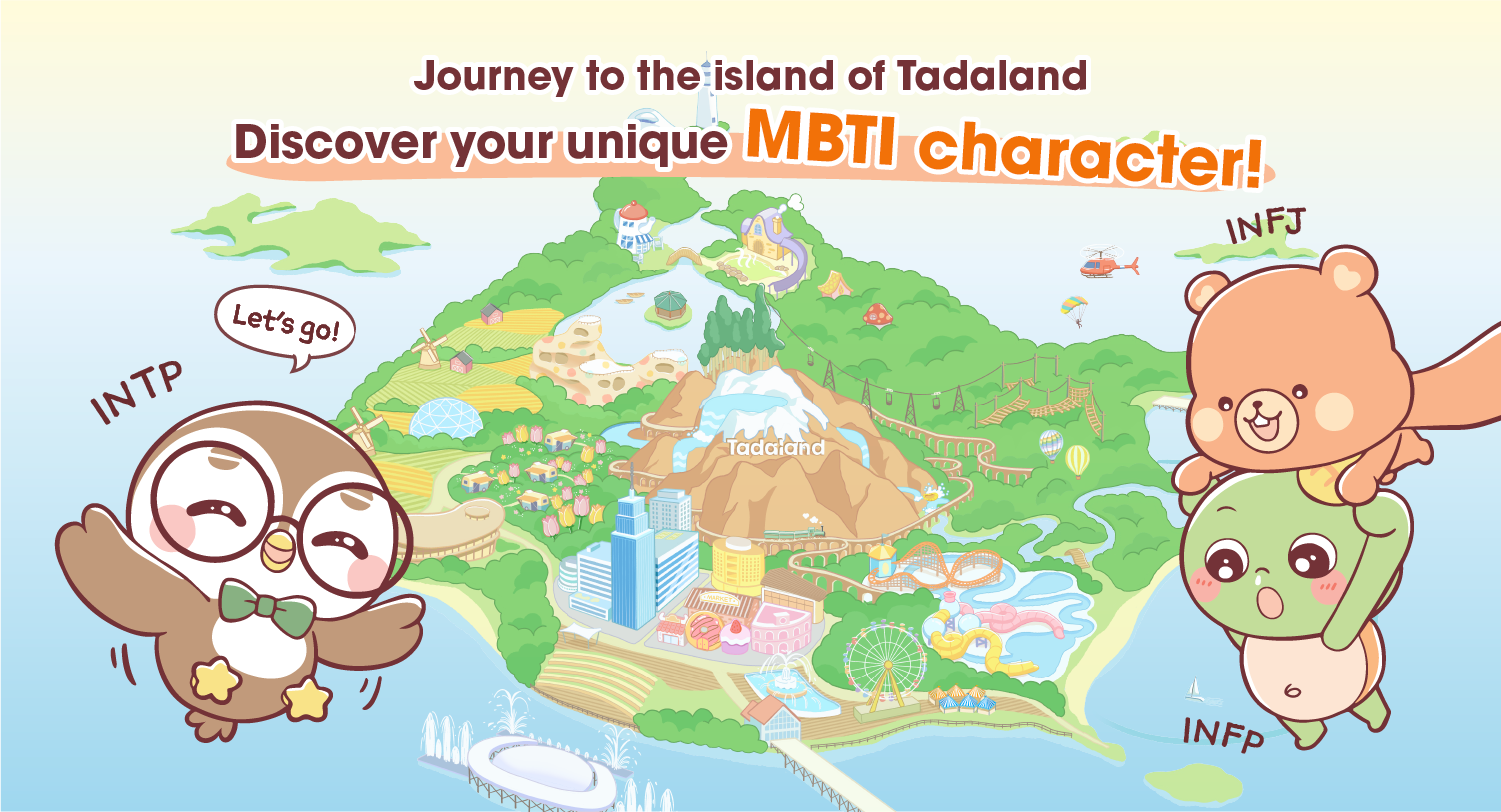
Once you know your four letters, you get a Tadamate rather than a verdict — meet all sixteen and see which one you recognise.
An editorial note
MBTI-style typing is a framework for conversation and self-reflection, not a clinical or scientific assessment, and it should not be used for hiring, streaming students, or deciding anything about anyone's future. The characters above are fictional and the types assigned to them are our own readings.